Sunday, October 28, 2012

Philip Treacy


Philip Treacy
Michael Jackson's actual Thriller jacket with a smiley-face hat? Yeah, that happened at Philip Treacy's phenomenal collection tonight—his first show in London since 1999—as did a hat modeled on the Neverland ranch, complete with a miniature carousel, and a Swarovski-encrusted creation resembling a sparkling white glove. Treacy's trademark feather headdresses were also on show, as well as fantastic experiments with light, including one that covered the model's body entirely like a Christmas Tree.
This was as much a rousing retrospective of Jackson's stage outfits by his longtime co-designers Michael Bush and Dennis Tompkins as it was a millinery collection inspired by said outfits. Piling up the tributes further, Treacy dedicated the show to his late friends Isabella Blow and Alexander McQueen. Not one to miss a spectacle, Lady Gaga served as mistress of ceremonies, decked out in a floor-length pink veil and McQueen's Armadillo shoes as she introduced "the greatest milliner of all time."

Thursday, October 18, 2012

Chloé Celebrates 60 Years


It's been 60 years since Chloé's fateful debut collection at Le Café de Flore, a Rive Gauche favorite among artists and boho young things whose laissez-faire spirit came to define the label. On Friday, Chloé celebrated six decades in a diamond jubilee of historic proportions (because why should the Queen of England have all the fun?).

Historic, because the house's Egyptian founder, Gaby Aghion, made a rare public appearance. Surprisingly charismatic, even at 91, she held court in the newly renovated Palais de Tokyo as guests including Karl Lagerfeld, Carine Roitfeld, Franca Sozzani, Jonathan Newhouse and Emmanuelle Alt paid their respects, to the tunes of Little Boots and Cecile Cassel & The Twins.
The celebration also served to launch Chloé Attitudes, a retrospective consisting of 70 signature looks over the years. On display are archival pieces from each of Chloé's nine designers, starting with Gaby Aghion and continuing through Maxime de La Falaise, Karl Lagerfeld, Stella McCartney, Phoebe Philo, and, currently, Clare Waight Keller.

We caught up with curator Judith Clark, who told us, "A lot of this is being put together for the first time, so sometimes I have been the first person to see drawings, documents, and cuttings. What people underestimate about Chloé is how witty the designs have always been, how whimsical, and still exist in the same spirit."

Wednesday, October 03, 2012

Emanuela Naccarati>Deco Demi-Couture Collection/FW 2012 -13 /Rome


Glance Deco
FW 2012 -13Zora & Neva Emanuela Naccarati

Inspiration for the Deco demi-couture collection of 18 pieces submitted for the coming winter by the young designer Emanuela Naccarati.
The Heads, limited edition characterized by processes and dyes made by hand, are the result of meticulous workmanship and craftsmanship, use of materials absolutely natural and historical, the result of meticulous research into the archives of companies of Italian textiles.
The Outerwear have basic volumes, they become armor, imposing high shoulders clamshell; pants follow clean lines in fabrics complete male (cashmere, wool / cashmere and pure wool 120's of national production) blouses in bourette of
hand-dyed silk are limited edition, as well as the shirts in pure silk.
For the evening, faithful to the call Deco 30s, feminine imagery of Lucien Lelong and that of the photographer Hoyningen Huene clothes made with Indian saree because optical are also unique in shape, color and imagination:
geometric hours, playing with contrasts of colors, effects light / dark texture of hypnotic, sensual hours as in the one-shoulder neckline or V neckline down to the waist and reminiscent of the volumes of the creations of Jeanne Lanvin and Madeleine Vionnet.
A sound installation space and welcome guests into space lab designer. The work is the result of research and cultural craft designer who explores his collection with the sophisticated models and curvy fashion 30's, the elegance of the voltage architectural and structural forms of outerwear, and the renewed interest in heritage traditional Italian craftsmanship.
Skilled hands working tissues, selected from the archives of famous Italian companies, according to the dictates of craftsmanship and design research.


EMANUELA
Naccarati
BIOGRAPHY

Emanuela Naccarati is a designer from Puglia who lives and
works in Rome.
Thanks to the passion passed on from parents, drapers high fashion, milliner and grandmother, decides to undertake an artistic career, graduating the Academy of Costume and Fashion in Rome, the most prestigious school in the Italian context.

While studying
, he worked for small local productions. Then he won an internship at a prestigious costume workshop and begins his experience in the world of theater and cinema.
First as an assistant, then as a costume designer, accumulates eighteen years of experience in the world of opera and drama, cinema vintage and contemporary work in national and international productions.

Has no way of knowing that the "dress" in every facet: construction, functionality, workmanship and aesthetic experience without which the project would never come to a personal brand, zora & neva.

zora & neva for Emanuela is not a change, but an evolution dictated by the desire for uniqueness: each dress has its own history and its own path and she goes in search.

The brand was created to meet the curious spirits looking fabric in the shape and processing, hidden messages from the past: the experience lives on in new forms.

The search for materials, dyes craft and the geometric rigor of forms are witnesses of a style "unique" and timeless, which escapes from today's dynamic business by making his work a collection continuous.

Glance Deco made ​​his debut with the desire to reflect the artistic imagination of Emanuela, collecting the essential points of its formation: the dress is research, construction, detail
and aesthetics.

Sunday, September 30, 2012

How it Works


You do things.You try it, this way, that way. You stray, you flop and then you flip again, and something, some things come out of it.

You do them and please, please, you think, do not ask me what I'm doing, what my political take on this, for the moment now I just have a political in-take, the out is not political to my best knowledge. Fortunately, your knowledge is not best. You see, you do things.

And although most of them, you can honestly say, you know little about, the matter speaks for you. (Which, of course, does not mean you do not try to talk with it, for it, explain it, relate it and convey it, extrapolate it, and prove where it, the matter, stands).

Some of the works you work, frankly, are worthy of the highest criticism. They are, yes it has been said before, the flops. Or worse, they have the wrong ideas, wrong media, wrong impressions and plenty-wrong outcomes.

Yet within these plenty-wrong outcomes, things are born. And these things might just make connections, little roots holding on to little pieces of earth. Not that roots hold on to any particular piece, but this metaphor just decided to go its own way, and we at New Art listen to metaphors, so yes, there might be no palpable piece of anything that the roots hold to, yet the work (by now it is work) is starting to appear as if it were actually something, about something, into something, for something. It gains weight.

And then, at some ungiven points, not necessarily at the end or at any sort of finale, the Holy-Flip happens. It could be a form, it could be filled with air or helium, it could be pretty far away from you, but still yours, still stemming from this surprizing head. You might say "things came into place", but you have no clue what you are saying, you don't have the perspective, you just enjoy it, the fact that now it seems clear, there is a connection, things are being said which you knew you wanted to say or wanted someone to say, some other head maybe.

And you know what? When it works, it's so simple.

Monday, September 24, 2012

On the Fall Campaign Trail

Fall campaigns—that put a spring in our step, let us sleep in, fix us a daiquiri, and other summer-related metaphors...


Sunday, September 09, 2012

Louis Vuitton's Sweet Spot


Louis Vuitton will be seeing spots this summer, thanks to a collaboration with Japanese artist Yayoi Kusama. The famously dotty 83-year-old is known for her lifelong obsession with polka dots (which paved the way for Pop Art) and for checking herself into a mental institution in the 1970s. (Kusama is also the subject of a career survey that has made its way from Paris to the Tate in London. The retrospective will stop at New York’s Whitney Museum from July 12 to September 30—sponsored by Louis Vuitton, of course.)
Launching July 10, the capsule features polka-dotted tops, dresses, skirts and accessories, plus a cheeky see-through spotted rain coat. Inspired by a trip Marc Jacobs made to the artist’s Tokyo studio in 2006, the collection calls to mind another collaboration between Vuitton and a Japanese mega-artist, Takashi Murakami. And judging from these leaked images, it's just what the summer calls for.

(c) Hint

Friday, August 31, 2012

Burberry Resort 2013


While Resort 2013 has many designers looking ahead in the calendar, with spring-like palettes of mint, orange, and pink, Christopher Bailey took a more subdued mood for Burberry Prorsum. The designer stuck mostly to label staples like worn-in leather bombers, khaki trenches and a few fresh-looking flight jackets, all with his highly polished sex appeal.

Underneath the outerwear, meanwhile, were precision-pleated trousers for him and her, plus some pencil skirts in colors that were positively autumnal: goldenrod, olive-drab and aubergine. Perhaps instead of looking forward to spring, Bailey was yearning for that cold and gray time of year London does so well.

Friday, August 17, 2012

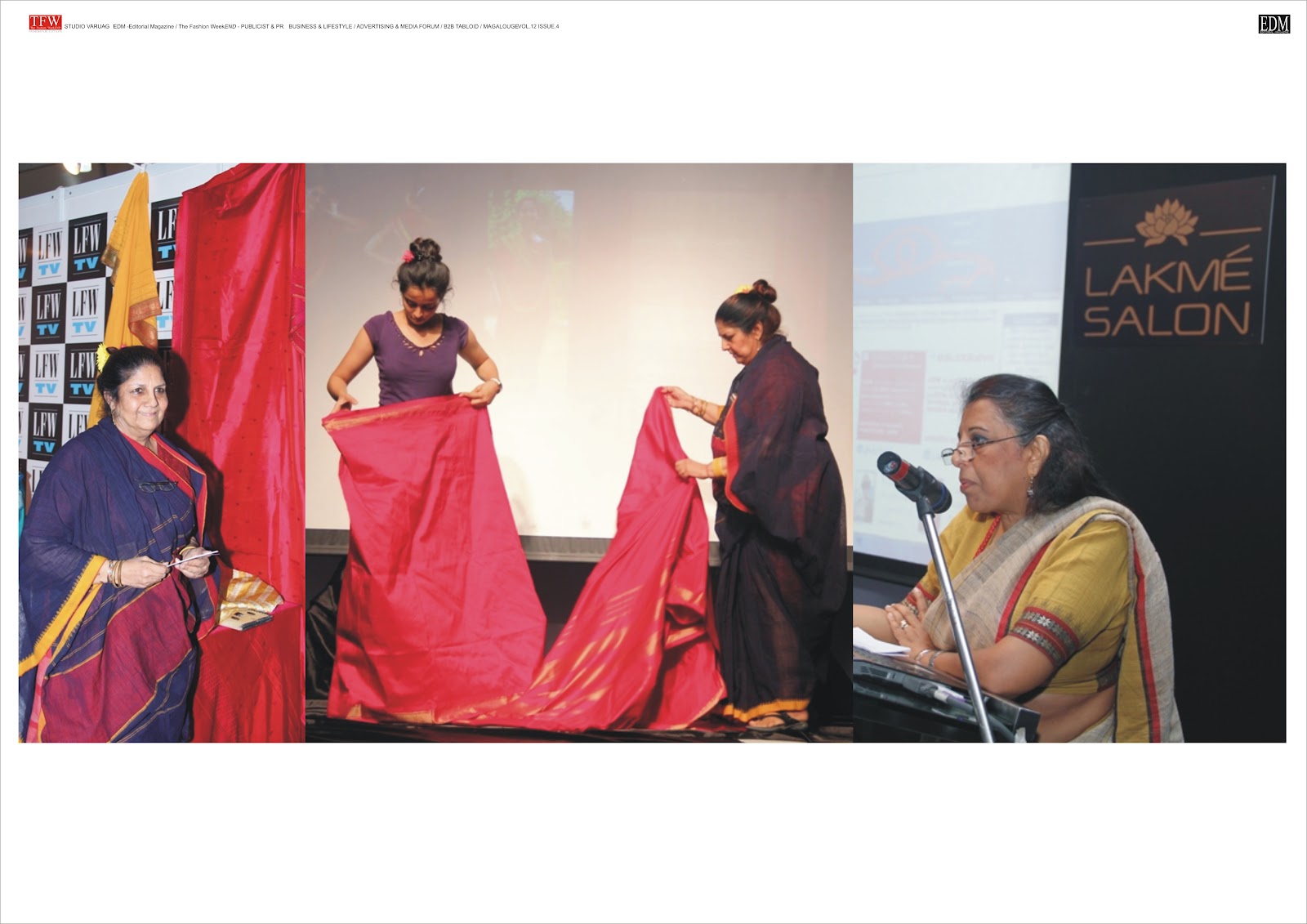
LAKME FASHION WEEK WINTER/FESTIVE 2012 Knowledge Sharing Workshops


The Knowledge Series Workshops were started during Lakmé Fashion Week Summer/Resort 2012 to celebrate the Indian Textile Day. The workshops featuring eminent experts in the field of crafts textiles and fashion who shared their views with the audience proved so popular that the second round took place during Lakmé Fashion Week Winter/Festive 2012


The first in the Knowledge Series Workshops at Lakmé Fashion Week Winter/Festive 2012 was held on August 5 2012 at Sajala the Source in the Usha Talent Box. It was an enlightening and very informative session with the venue packed with very eager and interested students, designers and media.


The keynote speaker was Jaya Jaitly, President of Dastkari Haat Samiti and the prime mover of India’s crafts people. On the panel were Krishna Mehta, Designer and Creative Director Krishna Mehta and promoter of arts and crafts in India. With her was Wendell Rodricks who has been instrumental in reviving the Kunbi sari of Goa. Completing the panel was Ritu Sethi, Chairperson of the Craft Revival Trust and Editor of the largest online encyclopedia on arts, crafts and textiles.


Presenting an interesting AV, Jaya Jaitly explained the different ways that Indian crafts and textiles can be promoted. “India’s crafts and textiles are well known but this is an area which shows beauty and ugliness of the lives of the crafts people. Our aim is to bring them to a new level. Artisans in Banaras at times do not know where their next day’s meal will come from.”


Ms Jaitly requested students to work in these sectors to uplift it. “We must have a sense of confidence in our heritage and not be standardized. Our culture reveals our identity.  It is necessary to understand the cultures of the people.”


Ms Jaitly then related a story of how Thai and Indian craft experts have different techniques of dyeing and how the latter from Kutch had a more natural system. The Akshara Project in Delhi created by Ms Jaitly encouraged artisans and craftsmen to use calligraphy for embroidery, prints and weaves which can send a message in different Indian languages as well as create an unconventional form of craft.


The panelists then joined in with Ritu Sethi emphasizing that in craft there is no boss or master. While Krishna Mehta felt that one has not yet touched the tip of the craft mountain. Wendell Rodricks related his experience with Kerala weavers who need to be promoted and encouraged. “Our country is the only one in the world besides Peru where we wear our clothes still. Our weavers need to be encouraged and promoted and given a more contemporary path to follow,” revealed Wendell.


The second workshop of the day was a discussion with Ritu Sethi Chairperson of the Craft Revival Trust and Editor of the largest online encyclopedia on arts, crafts and textiles who gave an interesting insight into her work.


Ritu Sethi, the famous handloom and Indian handicraft connoisseur presented an informative and in depth workshop about traditional Indian fabrics and textiles – from the art of making them to keeping the relationship between karigars strong so as to promote this beautiful process and to help Indian cultural art grow. The workshop was aimed at influencing design students to use handloom fabrics for they are the young generation, the ones who will bring back this art.


Ritu Sethi spoke of the importance of helping talented karigars out by involving them in design processes; “Why be lesser than you are?” she queried. She went on to say that there needs to be a harmonious balance between design and one’s roots.


She made a note of fashion being a ‘visual tool’, its importance being a giveaway to one’s class, value, ideals or simply where they see themselves. Making note of the fact that India has a handicraft culture dating back 5000 years she pointed out that whether for high end or mass consumption it’s important to stick to the root of why one is using this diverse art. “Original is always better, we are all original (people), aren’t we?” she asked when a student questioned if it’s alright to look for a cheaper alternative.


Speaking on the controversial plagiarism issue, she said if one were to go to a village in Kutch or any other place known for its textile work, one would be surprised or even shocked at the affordability which unfortunately sadly affects the quality of life of the karigars.


Before ending the seminar she then shared information about her website which can be found as the first option on Google when one looks for information on Indian textiles. Her website aims to be the new Wikipedia of Indian handlooms and handicrafts, offering information on karigars, Indian traditional work along with their geographic origin, etc.


Passionate and sincere, Ritu Sethi’s seminar imparted her wisdom with the younger crowd in a fun and knowledgeable way.


The first workshop of the day was an Interactive session with Rta Kapur Chisti author of "Saris: Traditions & Beyond" Rta Kapur Chisti is the founder of Ananda Delhi Textile, an organization devoted to the marriage of organic cotton farming and hand spinning in the production of khadi, the Indian textile championed by Gandhi. Rta Chisti, known for her extensive research into Indian traditional handloom pieces - especially saris, presented a humorous but informative workshop on Sari draping.


She started the workshop off saying, “If fashion is about reinvention then the sari is the ideal garment”, and also introduced her protégé and assistant, Pallavi Varma a textile collaborator who specializes in the art of weaving.

Keeping her talk fresh, Rta Chisti explained that it is the weaves of a sari that stand out before the embellishments followed by prints. “We don’t like to sit on the embellishments,” she said winking, making the audience laugh. The aim of the workshop was to share the magic of this unstitched garment; “Show your assets not your shortcomings,” she said before continuing on to explain the technicality of saris.

She explained that saris have three parts- body, borders and a pallav (end part). Another interesting fact shared by her was that the length of the sari determines the wearer- be it a young girl or an older woman. Going in depth into the size of the borders she explained that the sizes are: 1 inch- the size of one’s eyes, two inches- the size of one’s lips, three inches- the size of a forehead, four inches- crossed fingers, five- the size of closed hands in prayer. She also pointed out that the largest can be nine inches for the maximum inner border.

“We’re going backwards instead of forward. Let’s not compete with China, we’re a democracy,” she said. She also made a note of her own group which produces 40 varieties of tussar silk and 2 of mugha.

“You’d be surprised. It’s of the future not of the past, there’s so much you can do,” she said enthusiastically as she took the audience all over the Indian subcontinent, making note of each city and state, pointing out their traditional specialty and her adaptation of their sari wearing styles to something that is modern yet in touch with Indian roots.

Tuesday, July 31, 2012

Hats Elsa Schiaparelli Would've Worn If She Dabbled in Bondage


Based in the south of Brazil, Face Couture is a quasi-millinery project by self-taught designer Felipe Caprestano, who "mixes art and fashion by appropriating tailoring techniques to create masks." Not just masks though. More like surreal headpieces Elsa Schiaparelli would have worn—if she dabbled in bondage.

For two years Caprestano has documented the making of each piece in an online journal. Viewers can follow the works in progress, but never the final result. Until now. Or rather, next week, when Caprestano will launch a new website featuring exquisite portraits of the masks, a few of which we've posted here...